Drughub Darknet Market: Facts, Risks & Scam Guide (2026)
Independent informational page · Last updated: 20 October 2026
Drughub darknet market — also written DrugHub — is the name of an English-language marketplace on the Tor network that trades primarily in controlled substances. This page is a neutral, research-based overview of what open-source threat-intelligence reporting says about the platform, why darknet markets like Drughub frequently end in exit scams or police seizures, and which scam warning signs appear ahead of a collapse. This website is not affiliated with any market, does not publish access links or mirror lists, and does not facilitate purchases in any way.
What is the Drughub darknet market?
According to the public Dark Web Marketplaces Guide maintained by cyber-intelligence company Searchlight Cyber, DrugHub became active around August 2023 and uses English as its predominant language. The reporting also notes three characteristics the platform is known for in the ecosystem:
- The operators claim to include former staff of WhiteHouse Market, a large drug-focused darknet market that closed voluntarily in October 2022 without exit-scamming — a reputation DrugHub leans on heavily.
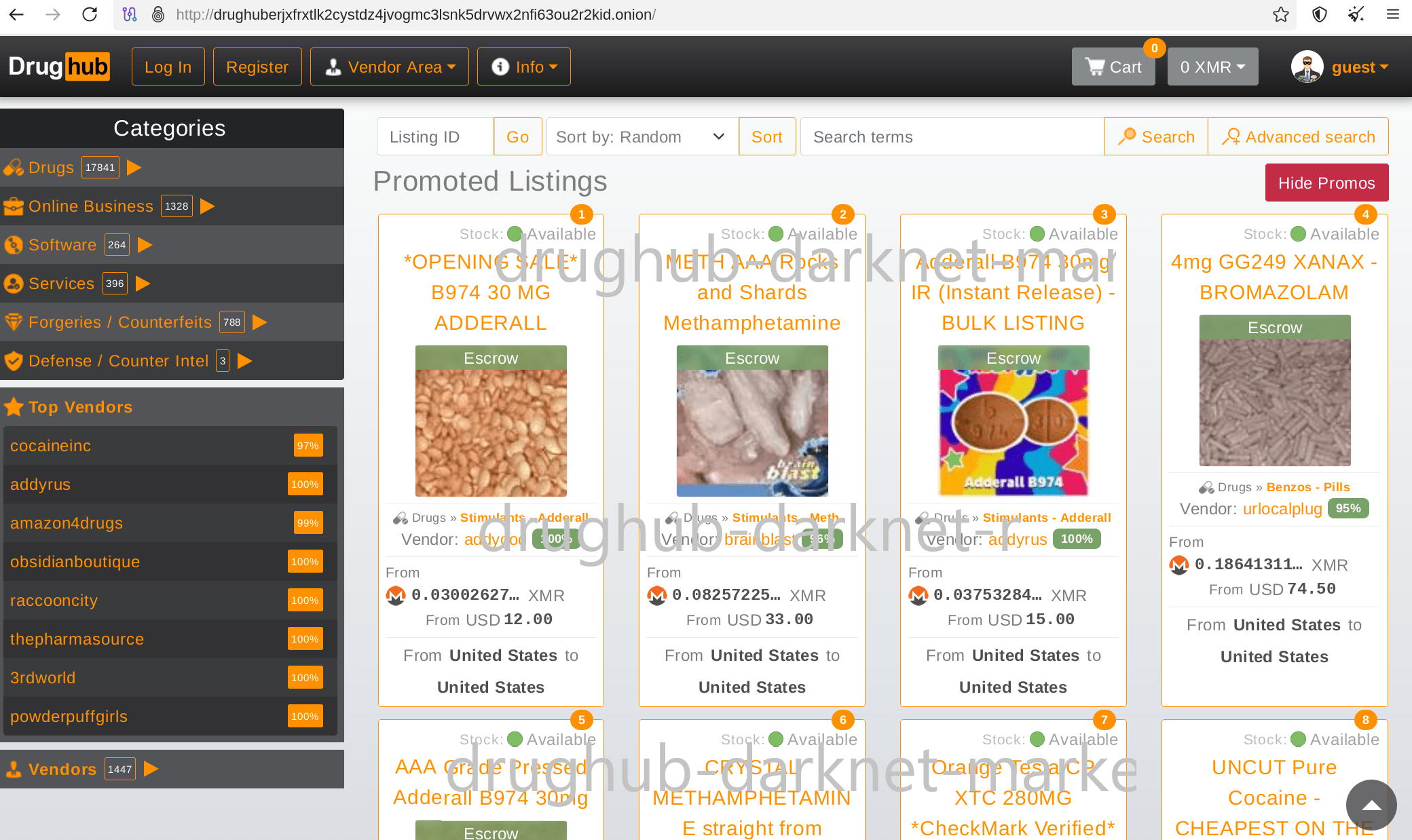
- The platform restricts payments to Monero only, requires PGP-based login, and offers a multi-vendor shopping cart.
- DrugHub absorbed the user base of another platform, SuperMarket, after one of SuperMarket's administrators was alleged to have disappeared with customers' on-site cryptocurrency.
DarkOwl's 2025 overview of darknet marketplaces ranked Drughub among the platforms with the largest number of distinct vendors and sustained listing volume. As of the most recent open-source reporting in 2026, public threat-intelligence posts indicate no confirmed seizure or shutdown of Drughub itself — though the category around it has seen significant churn (more below), and marketplace status can change from one week to the next. Note that the platform's reputation stems largely from claims made by its anonymous operators; there is no way for an outsider to verify who actually runs a darknet market.
How do darknet markets like Drughub end? The documented failure pattern
Darknet markets follow a well-documented lifecycle: launch, growth, pressure from law enforcement or infighting, and then one of two endings — a coordinated police takedown or an exit scam, where the anonymous operators simply vanish with all customer and vendor funds held in escrow. The EU Drugs Agency (EUDA) maintains a public dataset of market lifetimes and closure reasons that shows exit scams, raids, and hacks recur across the entire history of the ecosystem:
- Silk Road (2013) — seized by the FBI; its operators were prosecuted.
- Evolution (2015) — exit scam reportedly worth around $12 million in escrowed bitcoin.
- Empire Market (2020) — exit scam after months of uptime.
- Hydra Market (2022) — seized in a coordinated international operation.
- Incognito Market (2024) — collapsed amid a probable exit scam; one of its administrators was arrested and charged in the United States in May 2024.
- Abacus Market (2025) — went offline in early July 2025; blockchain-analytics firm TRM Labs assessed it as a likely exit scam, with a covert law-enforcement seizure not excluded.
- Kerberos (2026) — per Searchlight Cyber, believed to have exit-scammed in February 2026.
Two takeaways matter for the Drughub market context specifically. First, size and reputation do not protect users — several of the collapsed markets above were, at various points, the largest or most trusted platforms in the ecosystem. Second, an active market faces a structural dilemma: its operators can keep growing revenue (increasing exposure to enforcement) or cash out — and only they know which they will choose. TRM Labs' analysis of the 2025 Abacus collapse explicitly named DrugHub among the successor platforms facing this same pressure.
Is the Drughub darknet market a scam? Warning signs to know
This page does not rate the trustworthiness of any marketplace — after the record above, treating anonymous escrow funds as safe should be understood as a mistake. What we can do is document the recurring warning signs that open-source reporting has associated with market trouble or outright fraud:
- Withdrawal freezes excused by “DDoS” or “maintenance” — a common precursor to the Abacus exit scam, where withdrawal complaints began weeks before the disappearance.
- Sudden “migrations” to new mirrors, often with new addresses pushed out by unsourced channels — a classic fraud vector, because any list of “official” mirrors can be fabricated.
- Promotional websites not run by the market — including lookalike domains much like this one — that funnel users to wrong addresses or to affiliate pages that profit from mistaken visits.
- Requests to bypass escrow: proposals to pay a vendor directly or to “top up” a wallet with the “help” of self-declared staff.
- Too-new vendors with dense review histories appearing right after another market collapses — recycled reputations are a known manipulation.
- Community-forum alarms that the operators deny — in the Incognito case, the operator's denial posts turned out to be worthless and part of the attempted cover-up (its admin even attempted to bribe the forum administrator to delete scam warnings).
- Any guarantee of anonymity — payments, even Monero-denominated, leave a forensic trail that law-enforcement analyses have repeatedly used.
Note the definition of this domain's own risk class: the web is full of fake “Drughub” pages, reviews, and mirror lists precisely because the brand attracts mistaken traffic. An honest informational page does one thing — it tells you the risks and points you to legal help. A scam page will always offer you a link.
Legal and personal risks of using the Drughub darknet market
Criminal liability
In most jurisdictions — including the United States, the United Kingdom, the EU member states, Canada and Australia — buying controlled substances is a criminal offence regardless of the communications technology used. Receiving drugs through the post can itself constitute possession and, in many legal systems, drug-trafficking offences with multi-year maximum sentences. The FBI maintains a permanent darknet enforcement program (JCODE) precisely against these marketplaces, and international takedowns of drug markets are routine news.
Financial loss without recourse
Funds deposited with a darknet market are controlled by people whom no customer has ever met. When an exit scam happens — and the record above shows it happens at scale and without warning — there is no chargeback, no customer protection, no insurer, and no agency to complain to. Prosecutions of market operators recover far less than victims lose.
Health risks
Products sold on drug-focused markets are entirely unregulated. Synthetic drugs of a “same-named” category vary wildly in active dose between one press batch and another, which is a direct driver of accidental overdose deaths investigated by agencies such as Europol and the EU Drugs Agency. There is no consumer standard, no labelling, and no verification independent of the vendor's own claims.
Privacy and identity exposure
Market databases have been seized in bulk during enforcement operations. Being on one of these platforms means your past transactions can appear in a criminal case entirely outside your control — as defendants in takedown prosecutions have repeatedly learned.
Frequently asked questions
What is the Drughub darknet market?
An English-language darknet marketplace active since around August 2023, focused mainly on controlled-drug listings, notable for Monero-only payments, required PGP login and its operators' claim of former WhiteHouse Market staff. Open-source researchers (Searchlight Cyber, DarkOwl) have tracked it as one of the more visible drug markets in 2025–2026, with no confirmed seizure or shutdown reported as of October 2026.
Is DrugHub legit or a scam?
“Being active in open-source reports” is not the same as “being trustworthy”. The category's history includes platforms absorbing the users of collapsed predecessors — DrugHub took on SuperMarket's user base after one of that market's admins allegedly vanished with funds — yet any darknet-market escrow can exit-scam or be seized. From Evolution (2015) to Abacus (2025), the pattern repeats. Treat any funds held by an anonymous market as unrecoverable by default.
Does drughub-darknet-market.co provide links or markets access?
No. This is an independent educational page about how such markets fail and which scams surround them. We do not publish access details, mirrors, vendor contacts or instructions of any kind.
Is it legal to buy controlled substances on darknet markets?
No, in effectively every major jurisdiction it is a serious criminal offence, and receiving them through national postal services can itself constitute trafficking offences. Enforcement action against these platforms is continuous (see the FBI's JCODE program and the EU Drugs Agency dataset on market closures).
What are the warning signs of darknet-market scams?
Withdrawal freezes with technical excuses, unverified “new mirror” announcements, promotional domains with affiliate incentives, requests to bypass escrow, recycled vendor reputations after market collapses, and operator denials of scam rumours on community forums — as documented in the Incognito and Abacus cases.
Sources
- Searchlight Cyber — Dark Web Marketplaces Guide (DrugHub entry)
- TRM Labs — Abacus Market likely exit scam, July 2025
- DarkOwl — The State of Darknet Marketplaces in 2025
- EU Drugs Agency — dataset: lifetime and reason for closure of global darknet markets offering drugs
- FBI — JCODE: what makes darknet marketplaces dangerous
- Wikipedia — Darknet market (history of exits and scams)
- The Record — White House Market shuts down (October 2022)